
Research
Research
I intend to obtain a complete understanding of the fate and transformation of airborne organics across indoor and outdoor environments and assess their impacts on aerosol formation and human health.
Theme 1
Deposition vs. oxidation
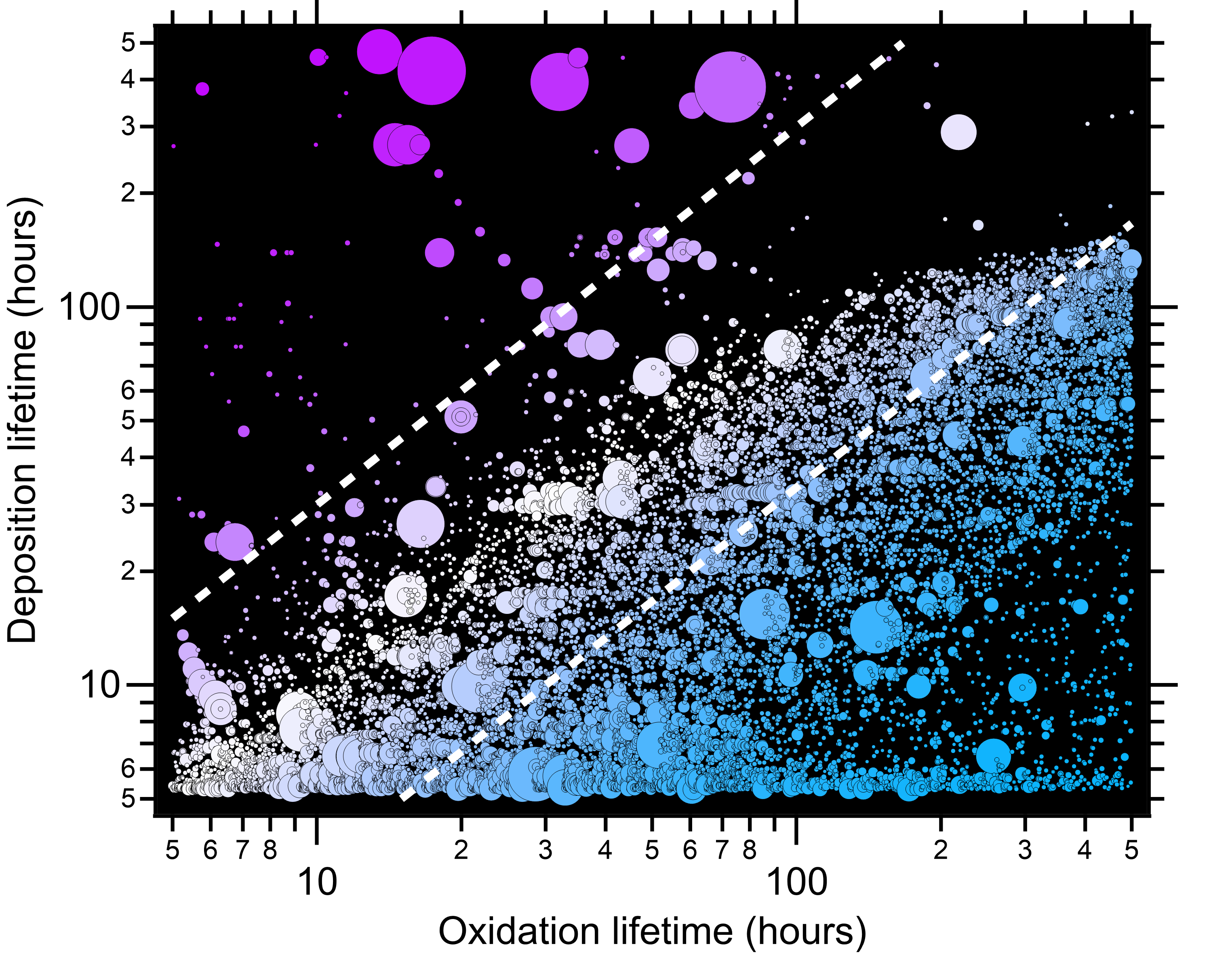
Modeling the impact of deposition of gaseous organic compounds on atmospheric oxidation.
- Developed a framework of competition between oxidation and deposition and demonstrated that reactive organic carbon in the transition regimes accounts for a major fraction of both atmospheric reactivity and potential for secondary aerosol formation.
- Demonstrated an approach to estimate the timescales of wet deposition of gaseous organics using basic real-world precipitation data.
- Investigated the impact of deposition on atmospheric chemistry using a 0-d box model of photochemical oxidation and regional air quality models.
Key papers: Bi & Isaacman-VanWertz, Nature Geoscience (2025) · Bi & Isaacman-VanWertz, Environ. Sci.: Atmospheres (2022) · all →
Theme 2
Instrumentation development
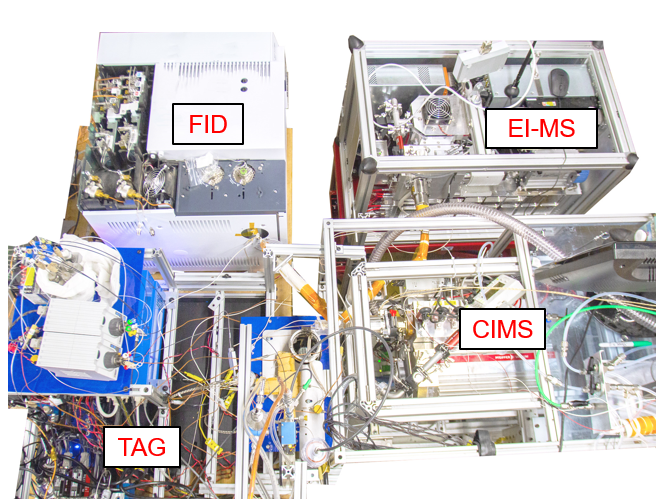
Isomer-resolved measurements of particle-phase organic compounds.
- Developed a field-deployable, online instrument for isomer-resolved quantification of particle-phase organics by coupling a flame ionization detector (FID) and a chemical ionization mass spectrometer (CIMS) to a gas chromatograph (GC).
- Demonstrated using a coupled FID as a calibration tool for quantifying CIMS sensitivity to unknown species, and applied it to examine the “voltage-scanning” method.
- Quantified the bias in log-linear calibration curves and developed a parameter-explicit solution that removes it.
- Studied the isomer-resolved composition of SOA in an oxidation flow reactor, and SVOCs in a university conference room during a two-week deployment.
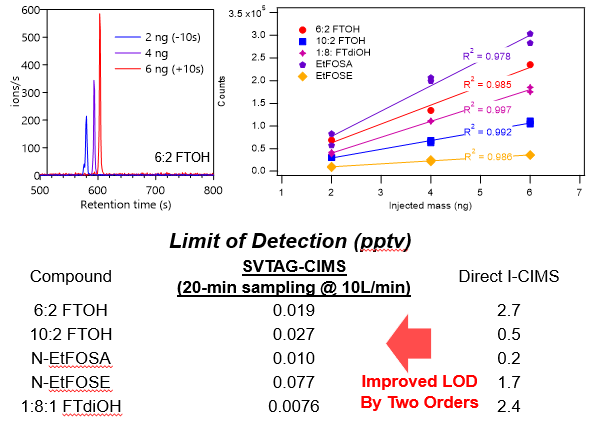
Novel instruments for PFAS measurements.
- Evaluated superoxide chemical ionization mass spectrometry (O2− CIMS) for real-time, gas-phase measurements of per- and polyfluoroalkyl substances (PFAS).
Key papers: Bi et al., Atmos. Meas. Tech. (2021a, 2021b, 2021c) · Hu et al., Analyst (2026) · Kumar et al., Anal. Chem. (2025) · all →
Theme 3
Indoor air quality and exposure
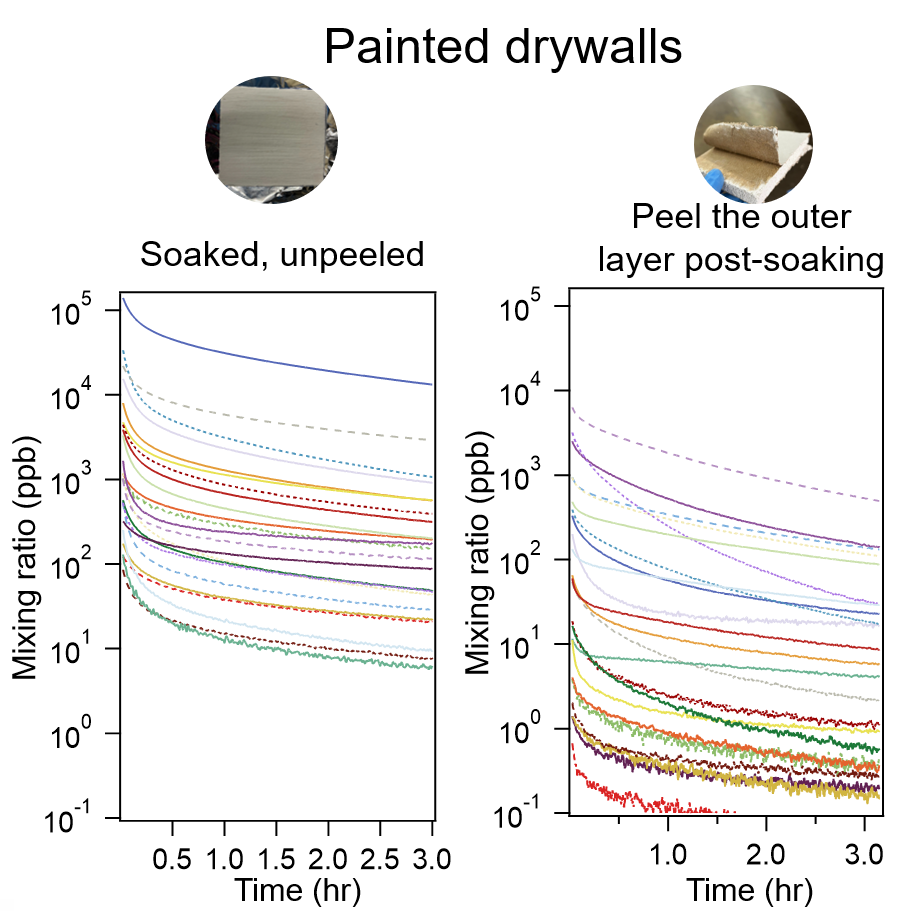
Wildfire smoke and indoor surfaces.
- Measured how interior paint changes the re-emission of reactive organic carbon (ROC) from drywall contaminated by wildfire smoke.
Emission, fate, and transport of phthalate plasticizers in a residential test house.
- Investigated the partition dynamics by monitoring phthalate concentrations in air and on various indoor surfaces (e.g., dust, clothing, windows, mirrors, dishware) in a full-size residential test house with controlled indoor temperature over a year.
- Developed and validated a room-scale SVOC emission and transport model using the measured data in the test house.
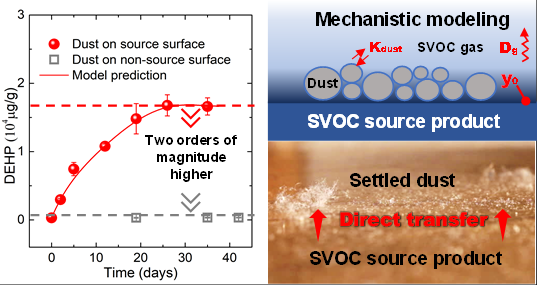
Direct transfer of SVOCs from indoor source products to dust.
- Monitored the accumulation of phthalates and phthalate alternatives in dust settled on vinyl floorings and crib mattresses in a custom test chamber.
- Developed a mechanistic model to predict the elevated phthalate concentrations in dust in contact with the source materials.
- Estimated children’s potential ingestion exposure to dust-phase SVOCs through frequent dust pick-up and hand-to-mouth behaviors.
SVOCs in the dust of U.S. low-income homes and childhood asthma.
- Organized field operations and measured phthalates and organophosphates in settled floor dust and HVAC filter dust in winter and summer in 59 low-income homes in Texas.
- Investigated associations between SVOC concentrations and building characteristics with statistical methods.
- Found a positive association between childhood asthma severity and SVOC levels in HVAC filter dust.
Key papers: Hurley et al., Indoor Environments (2026, in press) · Bi et al., Environ. Sci. Technol. (2015) · Bi et al., Environ. Sci. Technol. (2021) · Bi et al., Environment International (2018) · all →
Theme 4
System of systems
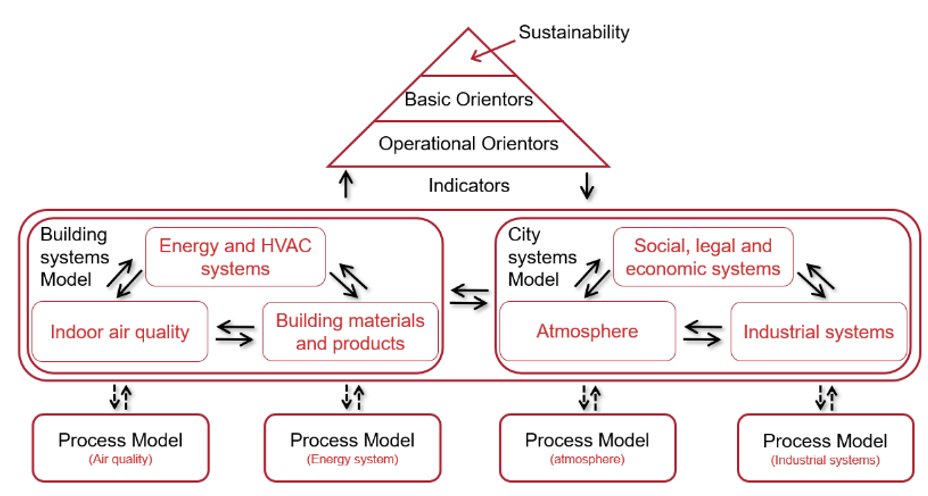
Integrated assessment across building and urban scales.
- Reviewed, categorized, compared, and evaluated existing assessment approaches to socio-environmental problems at the building and city scale.
- Proposed a unified framework based on the system-of-systems concept that connects the building and urban environment.
Key paper: Bi & Little, Sustainable Cities and Society (2022) · all →

